HOWDY!
I'm Meg, a local guide living in Austin, Texas — now in my 10th year here.
When I bought a Tesla last month, the first thing that surprised me wasn't actually the car itself — it was the insurance.
Of course, I made plenty of discoveries about the car, like the acceleration of an electric vehicle and the convenience of charging just by plugging into an outlet. But during the purchase process, when I compared Tesla Insurance with regular private insurance, I felt that the way we think about auto insurance may be about to change dramatically.
1. The Difference Between Tesla Insurance and Private Insurance
With typical auto insurance, premiums are determined based on age, address, driving history, accident history, vehicle model, and so on.
In other words, it's a system that sets prices by estimating "how likely this person is to have an accident" from past information and attributes.
Tesla Insurance, on the other hand, analyzes a driver's safety based on driving data collected from the car and reflects it in the premium.
Daily driving behavior is evaluated — for example, how often you brake hard and whether you keep a safe following distance.
What I found particularly interesting was that using the self-driving features affects your monthly premium.
Even if the premium feels high at first, as you use Tesla's self-driving features and build up safe driving data, the premium may gradually go down. This is quite different from the traditional way of thinking about insurance.
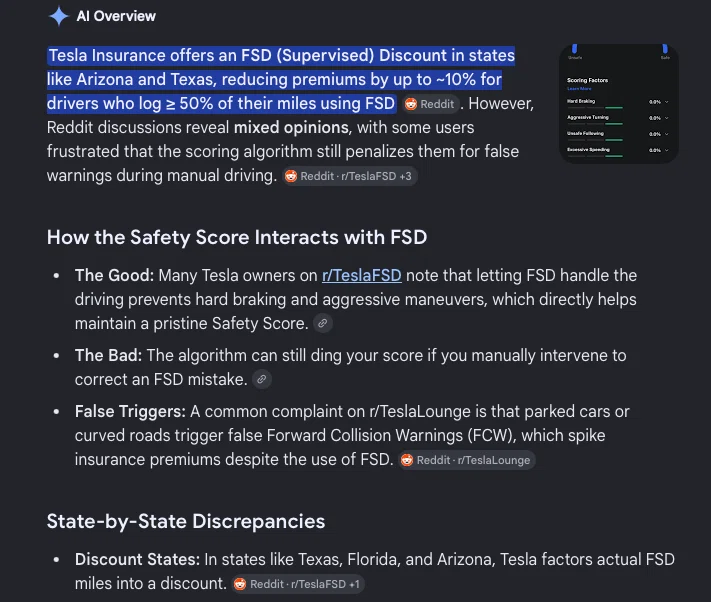
In Texas and Arizona, subscribing to FSD can also get you an insurance discount
Whereas insurance used to be determined by "what kind of person you are," Tesla's insurance changes based on "how your car drove this month."
Premiums aren't reviewed once a year — they fluctuate more in real time based on the car's driving data.
To me, this felt like the "real-time-ization of insurance premiums."
2. Tesla Insurance Is a "Driving Report Card"
The essence of Tesla Insurance isn't simply cheap insurance offered by Tesla — it's a system in which the car watches how you drive, evaluates it, and reflects it in the price.
It's like a monthly "report card."
For example, people who brake hard often or follow too closely may be judged as high risk.
On the other hand, people who maintain stable driving while using FSD (Full Self-Driving) may be evaluated as safe drivers. Insurance premiums are no longer fixed — they change based on your own driving behavior.
While this is convenient and rational, it's also a little scary.
That's because the car is monitoring your driving, and the results are reflected in your premium. Drive safely and you benefit; drive riskily and that comes back to you as a number too.
But on the flip side, it could have a positive effect: more people might make an effort to drive safely in order to keep their premiums low.
3. When an Accident Happens, Who Is Responsible?
So, as self-driving becomes more widespread, who takes responsibility when an accident occurs?
Although today's Tesla FSD has "Full Self-Driving" in its name, it doesn't leave everything to the car.
It's premised on the driver supervising at all times, and at this point, responsibility basically still lies with the driver.
What happens as self-driving technology advances further and the car takes on more decisions?
Was the accident caused by driver inattention, a software misjudgment, a sensor malfunction, or the manufacturer's design?
We can expect those boundaries to become increasingly blurred.
I think insurance in the age of self-driving will become not just a financial product, but a business that handles mobility data — speed at the moment of an accident, braking, whether self-driving features were engaged, and so on.
4. Self-Driving Business and Insurance Design Advancing in Texas
One place where you can feel this change up close is Austin, Texas, where I live.
Austin is home to Tesla's headquarters, and several self-driving taxi services operate here, including Google's Waymo and Amazon's Zoox.
Here, I'd like to clarify the difference between Tesla-style self-driving and Waymo-style robotaxis.
With Tesla, FSD is basically installed in a car owned by an individual, and the driver uses it while supervising.
The human is still the main operator, and insurance is an extension of personal auto insurance.
On the other hand, robotaxis like Waymo are mobility services operated by companies. Passengers don't hold the wheel; the operator's system takes them to their destination.
In this case, when an accident happens, what matters is how responsibility is shared among the operator, the vehicle manufacturer, the software developer, and the insurance company, rather than an individual driver.
Even within self-driving, insurance design differs.
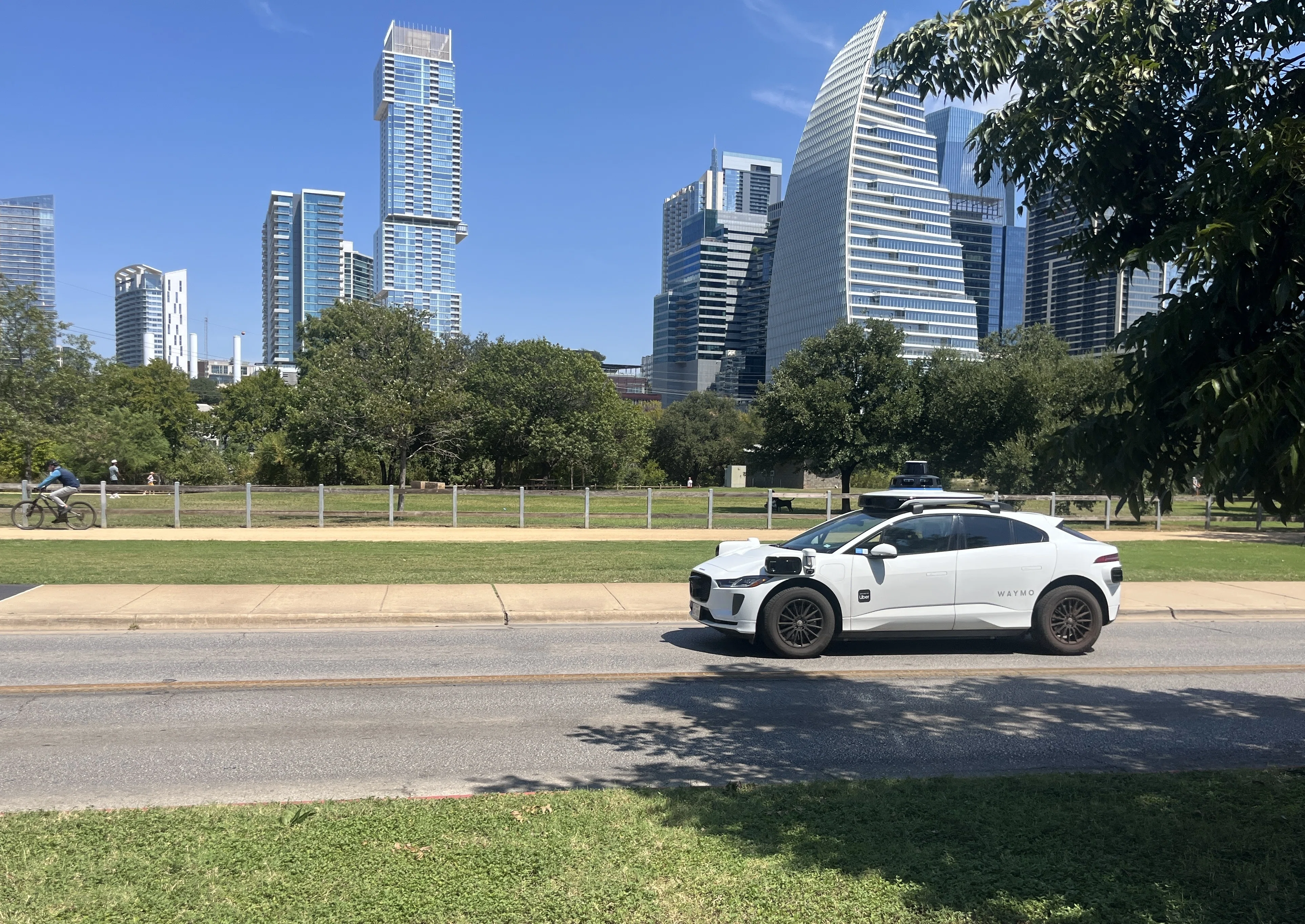
Google's self-driving taxi "Waymo" driving downtown
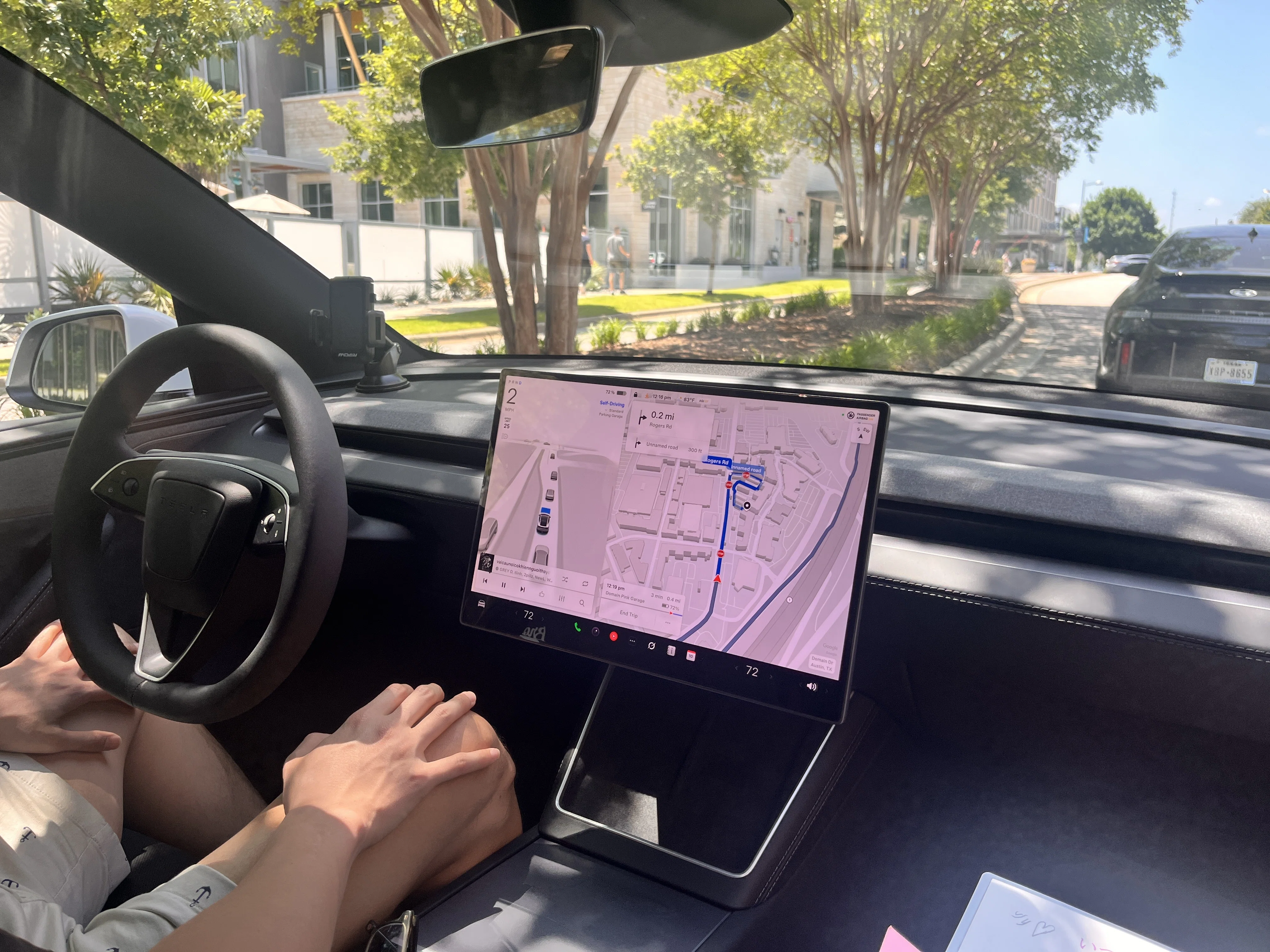
When you actually ride with Tesla FSD, the definition of driving changes.
It feels less like operating the car yourself and more like supervising a system.
You spend almost no time making fine adjustments to the accelerator or steering wheel, but there's constant pressure to watch your surroundings and be ready to intervene immediately when needed.
For example, when you need to change lanes to avoid the middle of the road because of construction.
Or when a parking lot entrance is one-way but the navigation doesn't reflect that — in those cases, you use human judgment and switch to manual driving.
For now, human intervention is still needed, and the common understanding that the driver is responsible if an accident occurs hasn't changed. But a future where self-driving is the norm will change insurance premiums, change accident liability, and change the value of the data generated by cars.
Self-driving isn't just changing cars.
Insurance, liability, data, and the very way we think about mobility are beginning to change in real time.
About Pathway Connect
Based in Austin, Texas, we provide American market research and local guide services. Our strength lies in delivering real-time research and trend information tailored to local needs.
We offer Tesla FSD ride experience tours.
We can also prepare a customized plan just for you based on the places you want to visit and the food you want to try.
Feel free to contact us!